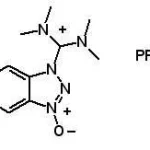
Coupling Reagents for Solid Phase Peptide Synthesis
Coupling reagents for peptide synthesis are used to form the amide bonds that link separate amino acids into peptides and proteins. They are also used to connect Boc amino acid or Fmoc amino acids to peptide synthesis resins, connect peptide synthesis linker molecules to base resins, and to form ester bonds in depsipeptides. Peptide coupling reagents react with protected amino acids to form activated amino acid intermediates which in turn react with the N-terminal amine of the peptide to form the elongated peptide. Formation of the activated amino acid intermediate can cause partial racemization of the amino acid which introduces impurities and reduces the yield of the desired peptide product. To minimize this problem, peptide coupling additives such as Oxyma are used with the coupling reagents to suppress the racemization of the activated amino acid intermediate.
Showing 1–25 of 27 results